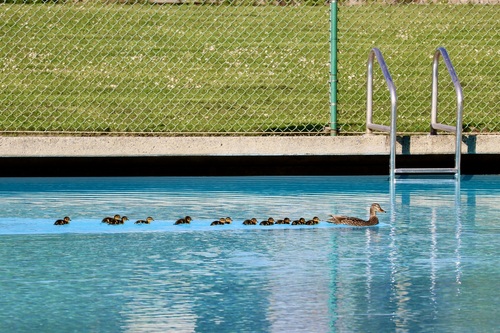
Mallard
Anas platyrhynchos
English
The mallard () or wild duck (Anas platyrhynchos) is a dabbling duck that breeds throughout the temperate and subtropical Americas, Eurasia, and North Africa. It has been introduced to New Zealand, Australia, Peru, Brazil, Uruguay, Argentina, Chile, Colombia, the Falkland Islands, and South Africa. Belonging to the subfamily Anatinae of the waterfowl family Anatidae, mallards live in wetlands, eat water plants and small animals, and are social animals preferring to congregate in groups or flocks of varying sizes. Males (drakes) have green heads, while the females (ducks) have mainly brown-speckled plumage. Both sexes have an area of white-bordered black or iridescent purple or blue feathers called a speculum on their wings; males especially tend to have blue speculum feathers. The mallard is 50–65 cm (20–26 in) long, of which the body makes up around two-thirds the length. The wingspan is 81–98 cm (32–39 in) and the bill is 4.4 to 6.1 cm (1.7 to 2.4 in) long. It is often slightly heavier than most other dabbling ducks, weighing 0.7–1.6 kg (1.5–3.5 lb). The female lays 8 to 13 creamy white to greenish-buff spotless eggs, on alternate days. Incubation takes 27 to 28 days and fledging takes 50 to 60 days. The ducklings are precocial and fully capable of swimming as soon as they hatch. The non-migratory mallard interbreeds with indigenous wild ducks of closely related species through genetic pollution by producing fertile offspring. Complete hybridisation of various species of wild duck gene pools could result in the extinction of many indigenous waterfowl. This species is the main ancestor of most breeds of domestic duck, and its naturally evolved wild gene pool has been genetically polluted by the domestic and feral mallard populations. The mallard is considered to be a species of least concern by the International Union for Conservation of Nature (IUCN), and, unlike many waterfowl, is considered an invasive species in some regions. It is a very adaptable species, being able to live and even thrive in urban areas which may have supported more localised, sensitive species of waterfowl before development.
Français · Canard colvert
Le Canard colvert, col-vert, ou Canard malard au Canada, est une espèce d'oiseaux de l'ordre des Ansériformes, de la famille des Anatidae et de la sous-famille des Anatinae. C'est certainement le plus connu et reconnaissable de tous les canards, du fait de l'existence de races de canards domestiques issues de cette espèce.
Español · Ánade azulón
El ánade real, ánade azulón o pato de collar es una especie de ave anseriforme de la familia Anatidae. Es un ánade de superficie muy común y extendido por el hemisferio norte. Habita áreas de temperatura templada de Norteamérica, Europa, Asia y el norte de África. Como ave migratoria también frecuenta Centroamérica y el Caribe, y ha sido introducido en Australia y Nueva Zelanda.
Русский · Кряква
Кря́ква — птица из семейства утиных (Anatidae) отряда гусеобразных (Anseriformes). Наиболее известная и распространённая дикая утка. Длина тела самца около 62 см, самки — около 57 см, масса достигает 1—1,5 кг. Голова и шея самца зелёные, зоб и грудь коричнево-бурые, спина и брюшная сторона тела серого цвета с тонкими поперечными пятнышками. Окраска самки бурая с более тёмными пятнышками, брюшная сторона буровато-серая с продольными пестринами. На крыле у самца и самки сине-фиолетовое «зеркало».
العربية · بركة
البُرْكَة أو البط البري، يسمى أيضًا البط الخضاري أو البط الخضيري أو الشريف الخُضْري أو مجرد الخضاري ، طائر مهاجر في العادة يعيش في البحيرات والمستنقعات. ينتمي هذا البط على غرار البُطُوط الأخرى إلى الفصيلة البطية ورتبة البطيات، وهو مشهور باسم البري لوجود نُوَيْع يربى في المنازل والمزارع.
中文 · 綠頭鴨
绿头鸭 又名大头绿(雄)、蒲鸭(雌)、野鴨,古稱鳧,是一種水鴨,在溫帶和亞熱帶的美洲、歐亞大陸和北非繁殖。它被引進到紐西蘭、澳大利亞、秘魯、巴西、烏拉圭、阿根廷、智利、哥倫比亞、福克蘭群島和南非。這種鴨屬於鴨亞科的雁形目鴨科。雄鴨(公鴨)有綠色頭部,而雌鴨(母鴨)主要有棕色斑點羽毛。兩性翅膀上都有一片稱為翼鏡羽的白邊黑色或虹彩紫色或藍色羽毛區域;雄鴨尤其傾向於有藍色翼鏡羽。
Photo: Boris the Woodchuck · CC-BY-NC · View on iNaturalist · Wikipedia
See my other TRMNL plugins